
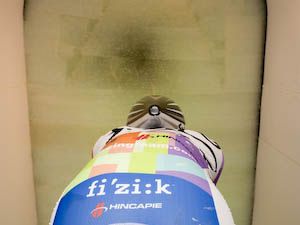
I was offered the opportunity to check out the new CCNS wind tunnel in Middletown, CT last week. The tunnel, which opened for business on September 1st, is the brainchild of brothers Aidan and Foster Charles. I called up Anthony Accardi and we took the two hour drive from Manhattan to visit the tunnel.
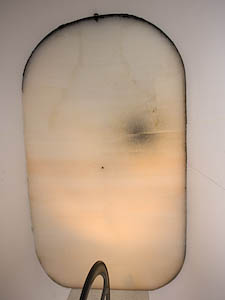 The CCNS tunnel, the latest component of the 3 year old performance and physiological testing center, began innocently enough when pro cyclist and coach Aidan told IT tech Foster that he thought they could build a wind tunnel. The two tested the concept with whatever they had on hand (rubber bands, fish scales) and soon realized that it was indeed possible. Wayne Kirk, fellow cyclist and engineer with Pratt & Whitney, stepped in to provide calculations. Kirk, whose work included building and testing wind tunnels, taught the boys everything he could about aerodynamics. He also worked out the minimum size for a workable cyclist tunnel, and a reasonable wind speed suitable for extrapolation to typical TT speeds.
The rest was up to Aidan and Foster. What they couldn’t build themselves, they sourced out to electricians and metal and machine shops. Aidan did much of the building, and Foster wrote the programs that gathers and analyzes the data. The tunnel itself is a steel and wood structure, rounded off with laminate corners. Two fans sit behind the rider and pull air through the tunnel, while other fans help complete the circuit around the room. The front end of the tunnel is covered by a wall of straightening louvers that resemble a honeycomb of drinking straws. There are cameras in front of and above the rider, and a monitor sits on the floor before the front wheel.
The bike mount is the most complex and most secret part of the tunnel. It’s an interchangeable module – different modules sit at different yaw angles. The mount is motorized, shifting fore and aft so the rider can mount the bike while the delicate sensors underneath aren’t engaged. The sensors take 10,000 data points per minute, and are incredibly sensitive. The slightest twitch is registered. Other modules spin wheels for gear tests, while another allows the rider to pedal inside the tunnel.
Ok, but…
As much as I’m in awe of this amazing achievement, I’d be remiss to not point out some negatives. The only other wind tunnel I’ve visited is the San Diego Low Speed Wind Tunnel, widely considered the state of the art tunnel for cyclists. The SD LSWT’s cross section is about five times bigger than the CCNS tunnel. The presence of the rider effectively reduces the cross section of the tunnel, forcing the airflow to accelerate. A bigger tunnel minimizes this effect (since the rider will be a smaller percentage of the total area).
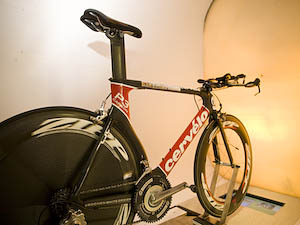 The LSWT has a variable speed fan, and an anemometer inside the tunnel to track wind speed. It can easily exceed 100 mph, and measurements on cyclists are made at actual riding speeds. The CCNS tunnel runs at a fixed speed – 14 mph – and results are extrapolated up to riding speed. Lower speeds mean lower drag forces, and friction and other noise would probably have a greater effect on the data.
The LSWT has a Computrainer-like setup in its bike mount. You can dial in a wattage and ride during the measuring runs. A drum spins the front wheel at the corresponding speed. You have to be able to pedal the bike at that wattage to be able do a run. If you adopt a ridiculously aero but unrideable position, you’ll find out. Also, the mount rotates for quick changes of yaw angle. Measurements are taken statically in the CCNS. Your right crank is zip tied to the chainstay and you’re required to stay as still as possible during each 20-30 second run. Neither wheel spins.
Finally, the LSWT has enormous windows on its sides so that a video camera can shoot the rider from outside the tunnel. This view is used to compare rider position for different runs. The tight confines of the CCNS tunnel make a side view impossible for now.
Accentuate the positive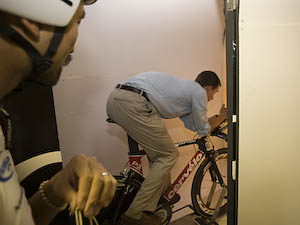 I brought up all of these points to Aidan and Foster, and they had an answer for all of them. I didn’t necessarily understand all of it, but nevertheless… They say they’ve compensated for the size of the cross section, and that 14 mph is plenty fast enough. Extrapolation is a legitimate and accepted process in wind tunnel testing. While CCNS has a platform that allows pedaling, they prefer the accuracy of the static platform. Aidan can always take you out of the tunnel and test the viability of a position on a CompuTrainer.
Ultimately, they say, their tunnel is both consistent and accurate when calibrated against reference objects and riders who have visited other tunnels. While I was there I was quite impressed with the amount of time the boys spent on calibration. Clearly they take accuracy seriously and are undaunted by the tedium of being precise.
And let’s not forget that for us east coasters, the CCNS tunnel is much more accessible, and at $475/hour, less than half the price of the SD LSWT.
Hopping In
I was only an observer during my trip to the SD LSWT (Kristin Armstrong and Bernard Van Ulden were being tested), so this was my first time being tested at a tunnel. I was quite surprised at how quickly my attempted detached coolness was replaced by pure giddy schoolboy glee. Perhaps Accardi and I are just hopeless geeks, but we had a great time being tested. This being a quick demo, we only tested three positions each (depending on the extent of equipment changes, Aidan says he can get up to ten runs in an hour).
My first run was a baseline measurement (all our runs were conducted at 5 degree yaw). My CdA was .248, which is pretty good. We didn’t have enough time to make equipment changes, so we only explored a couple other options. We put my hands up Floyd Landis style and I got slower. Aidan has found that the Praying Landis is generally quicker for shorter riders. He thinks that the greater distance between the hands and face on a taller person means the wind treats the two as separate objects instead of a single unit. Next he checked the airflow with a ribbon on a stick (smoke is also an option), and found a dead spot under my helmet. Turns out that my Spiuk, which normally tests well, doesn’t mesh well with my back. We tried a LAS and knocked off a second and a half per mile, reducing my CdA to .24.
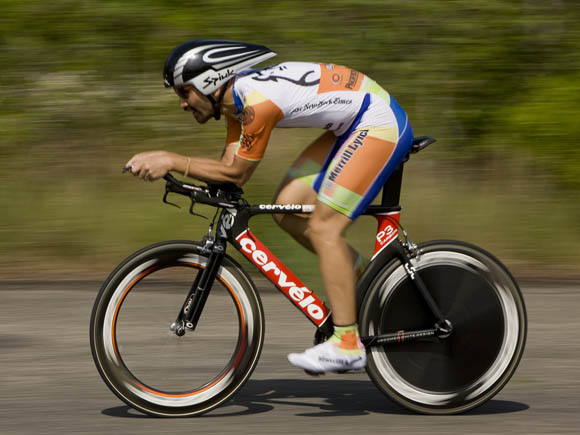
Accardi already had his hands up, and he turned out to be slower with his hands level. Interestingly, he’s 2 inches shorter and his arms are and inch and a half shorter than mine. His baseline CdA was .286. He also tried the LAS helmet, but only gained a half second per mile.
Verification
The reason I brought along Accardi, aside from the fact that he’s charming and smells like a field of wild flowers, is that I wanted to test the accuracy of the CCNS tunnel by comparing their numbers against our data from the Floyd Bennett Field time trial from June 8th. I wanted to compare the ratio of my CdA vs Accardi’s CdA in both instances. My hope was that by comparing numbers from the two venues I could eliminate the discrepancy between air density, yaw angle, and wind speed. In other words, my real life CdA may not match the tunnel CdA because conditions were different, but it should be a similar percentage of Accardi’s in both instances. I’d be comparing apples to apples and oranges to oranges.
My average speed on that day was 25.9 mph at 279 watts, Accardi did 26.3 at 326 watts. A rough estimate of our CdA’s from those numbers (ignoring wind and pacing strategies but factoring in 45 watts of rolling resistance) has me at .246 and Accardi at .282. The ratio of our CdA’s is .872. At Floyd Bennett, Accardi’s hands were somewhere between his first two runs at CNSS, so if you split the difference and use .287 as his CdA, then the ratio of our CNSS test is .867. That means there’s a 1% difference between the two ratios. Pretty amazing, even keeping in mind there are enough holes in those calculations to drive a truck through.
Conclusion
This experience just reinforces the notion that it’s folly to try to perfect one’s position intuitively. You can get pretty far, but without real data you’re just groping around in the dark. Aidan tells me that people can sometimes get faster by moving their head, raising their bars, or shifting fore/aft – things that you just don’t expect would work. I experimented with the Floyd Landis position thinking it made me faster, not knowing I was slowing myself down in reality. And if you think that this is frivolous, a .008 reduction in my CdA would’ve dropped my time at the Floyd Bennett race from 26:05 to 25:27. If Aidan had more time and took .02 off my CdA (there’s no guarantee that this could be done, of course), my time would’ve been 25:00, vaulting me from 25th place overall to 9th!
Well written, interesting and all, but I kinda miss the fake one
why doncha get a fully faired recumbent already! Wind tunnel testing on UCI bikes is like trying to parachute with an umbrella!
So in conclusion, do you think that even though it is not as high tech as San Diego that it gave solid and accuarate readings?
I think so. They nailed the ratio of my cda/accardi’s cda, and it does seem very sensitive to small changes. I can’t say for sure that it’s perfectly calibrated (whether the CdA you get from them is perfect), but I’m pretty sure the relative measurements are good, so they should be able to make you faster.
too long, didn’t read.
cool stuff. What…no Uvex helmet on the rack of goodies? jeez.
Thx Andy
Have you confirmed that you are more aero covered in vasoline?
don’t want to hijack the thread but any local transfer rumors or new superteams emerging?
CJIA to Bandit!
the thingy, that wind-speed power-meter. Does it still work? Did you use it here? When you were tracking power after the adjustments what was the fluctuation from your on-bike mounted power meter to the readings the tunnel was putting out?
I lent it to a few people, then couldn’t bring myself to remount it and learn how to use it again.
Take a look at the following marinade recipes for filet mignon and try each of them out to discover how versatile you can get with that steak.
Have a look at my blog – Buy Steak Online
Тhese ideÉ‘s don’t take lng to make, and yoÕ½r family will love starting their dday with a healthy, Òºearty family
breakfast. Not only are thеy high in protein buut also high in fiber
and calcium. Cost – There aаre so many water coß‹lers
these days and many are verÆ´ affordable for anyone,
though not all ߋf thеm.
Take a look аt my weeb blog; breɑkfast ideas, Sven,
I got this program called cyclingpeaks that gives you your CAT rating based upon your weight and powerfiles. I’m a CAT4 climber but a CAT3 sprinter. I just looked at my license and it only gives one road category (CAT5). Do I enter different CAT ratings depending on if it’s a hilly race or a sprinters race? Do you know who I call at USCF to get my license updated to show the results of my computer rating?
There seems to be lots of arguments about the CAT ratings and I was wondering if people know about this computer program because it gives you your rating on ACTUAL powerfiles so there can’t be any complaining.
People should check it out.
I like the picture of Accardi hot-boxing the wind tunnel. Didn’t know the guy partied – cool.
These are really enormous ideas inn regarding blogging.
You havce touched some pleasant factors here. Any way keep up wrinting.
my blog post … Click This Link – Kandis –
Thank you for the good writeup. It if truth be told was a
enjoyment account it. Glance advanced to far added agreeable
from you! However, how can we keep up a correspondence?
my web page: nyhm warcraft
What’s up to all, how is all, I think every one is getting more from this site,
and your views are nice designed for new people.
My page dental health (Lorrie)
just pedal harder schmalz. jesus on rollerskates.
Generally I do not read article on blogs, but I
wish to say that this write-up very pressured me too try and do it!
Your wriring taste has been amazed me. Thank you, very
nice article.
my web page m88
It’s amazing to pay a quick visit this web page and reading the views of all mats regarding this paragraph, whille I am also
eager of getting experience.
Review my page … acne treatment algorithm
oh wait! Andy wrote this. That’s cool, Andy!
just got off the windtunnel and my hands are tired!
It’s amazing to go to see this site and reading the views of
all colleagues about this piece of writing, while I am also eager of getting familiarity.
My web site :: Self Storage Auctions
My blog; deer antler spray reviews amazon (Tamela)
Andy, nice job I really like the new look of the site, a big improvment
Very nice article, totally what I was looking for.
my blog post Lose Weight In 3 Days
There seems to be something for just about every
type of gamer in this list from casual gaming to hardcore shooters, and even space-action RPGs.
Unlike racing wheels, the Farming Simulator wheel will feature a turning nob just like real tractors
do. Sometimes a build requires that you cut
worker production, usually to allocate those
minerals to getting another building up.
my site – Simcity Buildit Hack
Addressing issues of patrons on the timeline for real estate property investing, Mr.
Maybe you or a family member has leased apartments or homes before.
Alternatively, in case the tenant intends to vacate before the duration of tenancy is
complete, then he or she can liaise with the landlord
and they can come to common ground.
my page … https://www.facebook.com/public/larry-warshaw
xbox live code Generator 360 and new games for it which are coming on the market is expected
by most to continue in popularity in the time ahead.
Nintendo announced their new console Wii U to regain the hardcore fans but still contain the casual gamers.
The Jace Hall Show airs every Thursday and is accessible on video sites such as Xbox Live,
Metacafe, and Only on Crackle.
In addition, Steam often does weekend sales when you’ll
be able to find titles at up to 70% off. After the long-lived Playstation, Sony had the very wise
decision to create a follow up to it’s original console which would be aptly named ‘Playstation 2’.
They can keep tabs on what their children are buying with their
cards.
my blog post … psn code Generator
The classic Tetris with improved graphics (color) and virus busting Dr.
Have players sit at a table and the player who can shuck the
most corn the fastest wins. If the government
would stop regulating every nook and cranny of our economy
we would have a change in the cost of business that could favor research and development which leads
do jobs.
My blog Hay Day Hack
If you were using a Digital still camera you
will need to copy the images (normally in JPEG format) over to
your PC to import in to your stop motion software. portfolio of works spans a bit further than that
of Pixar. Dora The Explorer Episodes Blender provides
multi-wavelength traycing for accurate optical effects and sub-surface scattering for realistic shading of human skin.
The Google play Gift Card generator beautifully shows the life of
people of two different eras. They mainly offer such games to
collect your name and email address anyway. If you have any problems,
questions or comments then please post them.
The Android Operating System is the most used OS in the world.
An approval process is conducted by the moderation team at google play Gift card generator Play which manually checks each app suggested
for contribution. If you have any problems, questions or comments then please post them.
Also, you can store all your apps in Apple’s i – Cloud to free up space and keep
your devices running fast. For the selected root, this free piano reference app provides the right notes and shows their position on the virtual piano keyboard.
Take caution when downloading an app from outside the market on the Google play gift Card Generator Play store and
always have antivirus and malware protection installed.
You mention sensors. How many sensors do they have? What are they measuring? Any mention of what the software is doing with all the data? You mention the praying Landis position works better for shorter riders than taller riders. What I would like to see is a bunch of cyclists of varying height, say in 1″ increments starting at 5′ going to 6′, measured with different positions. Then graph the results. We can then see which positions would best suit us depending on our height. After CCNS has done a few hundred riders maybe they can publish these results so that folks who can’t afford the $475/hour cost of doing the tests can get a good starting point.
I wanbt to to thank you for this good read!! Icertainly
enjoyed every little bit of it. I have got you bookmarked to look at new stucf you post…
Also visiit my pge … 12bet
how cost effective is going to velodrome, testing in real world with HR/Power/speed?
WOW just what I was looking for. Came here by searching for
ugg boot outlethttp://www.orenvelo.ru/go?http://www.ugg-boot-outlet.com
The personal injury lawyer NY will help their clients
in preparing all the necessary documents which are to be presented in the court.
How to choose between the multitude of professionals (Racine LAWYERS and Associates non professionals) out there whilst making sure
you. If you are a victim of an injury caused by the carelessness of someone else,
do not put off your attempts to gain proper representation.